

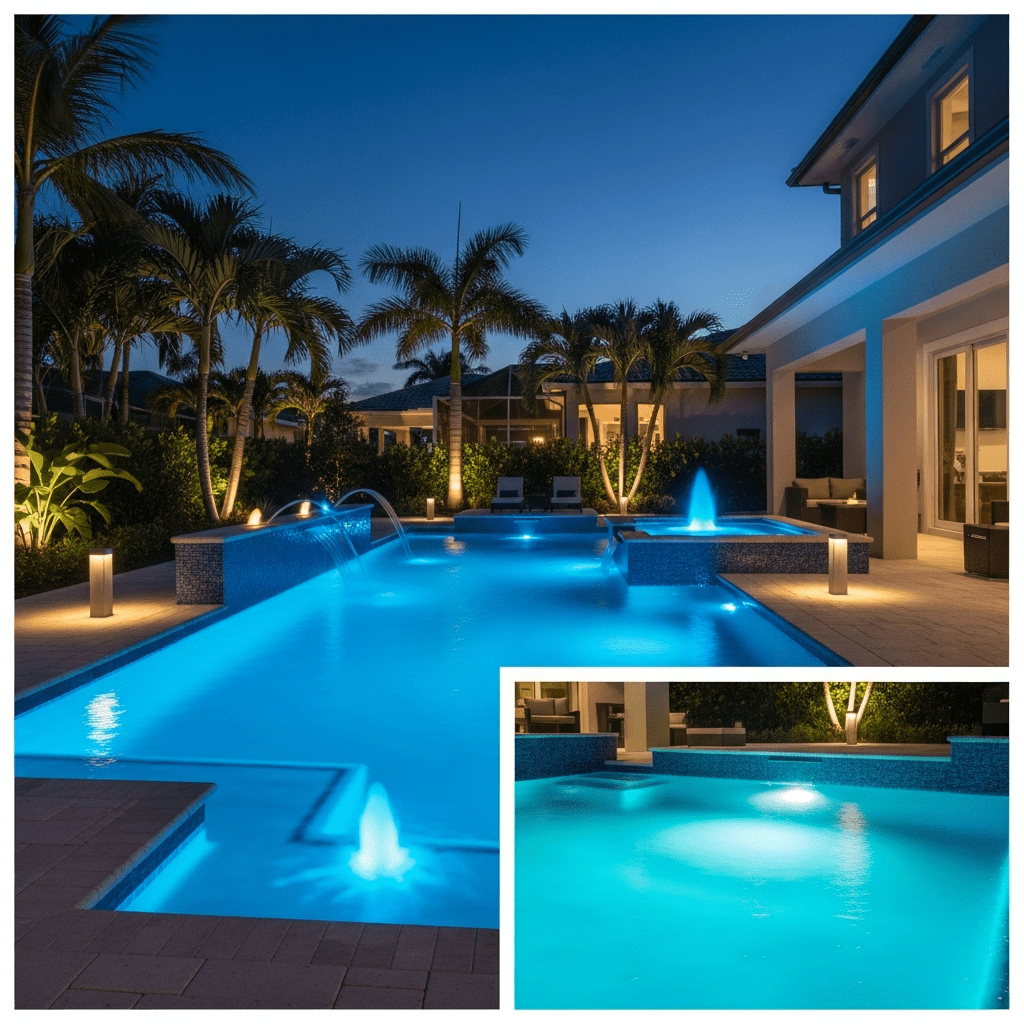
I’ve seen a lot of Fort Myers pools at night. Some look incredible. Some look like a parking lot. The difference is almost never how much money someone spent, it’s whether they thought about it at all, or just let the builder slap in whatever fixture was on the truck.
So here’s what I’ve learned, mostly the hard way, about lighting a pool around here.
Start with LEDs. This isn’t debatable anymore
If you’re still running halogen, you’re just paying more for less. LEDs last years, use a fraction of the power, and give you colors you can actually change. I replaced mine three years ago and haven’t touched them since. One thing though, if your pool is saltwater, check the fixture is rated for it. Salt eats cheap fixtures alive. And ignore the wattage on the box. Look at lumens. Watts tell you what it costs to run. Lumens tell you whether you’ll actually be able to see the bottom step.
The color-changing thing is worth it, but only if you’ll use it
I was skeptical about app-controlled lights. Seemed like a gimmick. Then my wife set the pool to deep blue for a dinner party and I got it. It changes the whole mood of the yard. The multi-zone setups are nice if you entertain a lot, spa one color, shallow end another. But be honest with yourself. If you’re not going to open the app, don’t pay for the app.
Fiber optics are the sleeper pick
Nobody talks about these enough. If you want that starfield look, or a soft glow around the steps without running power underwater, this is how you do it. The light source stays out of the pool entirely, which means less risk and no heat at the fixture. I’ve seen them paired with glass tile and it looks expensive in a way that has nothing to do with the price tag.
Light the steps. Please
This is the one I see skipped most often, and it drives me nuts. Underwater lights make the pool look pretty. Step lights keep your brother-in-law from cracking his shin on the entry steps after two beers. Recessed step lights, bench lights, low deck inlays, none of it is glamorous, all of it matters. Add a few path lights between the house and the pool while you’re at it. You’ll use them more than the fancy stuff.
Your lanai is half the yard. Light it like it
Most Fort Myers homes have a lanai or a screen cage, and most people leave it dark after sunset. Why? Sconces on the lanai wall, a dimmable fixture overhead, LED strip along the cage frame, suddenly the whole outdoor room works at night. Uplight a palm or two. Throw a strip light behind a planter. A lot of local installers here sell lanai packages that match your pool lights, so it all looks like one design instead of three.
Smart controls: nice, but plan for them before you build.
Voice control and scheduled scenes are genuinely useful, lights come on at sunset, everything dims at midnight, no fumbling for switches. But the real advice is for anyone building or renovating: run the conduit now. Extra low-voltage lines, spare runs, all of it. It costs almost nothing during construction and saves you a miserable weekend later. I learned that one after the fact.
Water features need their own light.
A waterfall that isn’t lit is just a noise at night. Uplight the spillway, the scuppers, the sheer descent, the moving water catches the light and suddenly it’s the best part of the yard. Just use marine-grade fixtures near the splash zones. Cheap ones fog up and die within a season.
Stop thinking in single lights. Think in layers
One bright underwater light makes a pool look flat and a little bit like a motel. What you want is layers: a soft underwater wash, step lights for safety, uplights on palms and architecture, path lights for navigation. Then put it all on dimmers and zones. Low romantic scene for dinner. Bright safety mode when the kids are in. Same pool, different jobs.
Now the boring part, which is also the important part
Fort Myers and Lee County don’t mess around with pool electrical. If you’re installing or changing pool lighting, there’s a good chance you need a permit, and you’ll likely need to submit a lighting or electrical plan. Florida building code has specific rules for pools used at night. I know permitting feels like a hassle. Do it anyway. Use an electrician or pool contractor who’s done Lee County permits before, they’ll get it approved faster and you won’t be the guy explaining an unpermitted install to your insurance company.
Maintenance, briefly
Buy fixtures with replaceable lamps or clear service access. Keep an eye on seals and gaskets. Back up your lighting control settings and label the wiring, future you will be grateful when the pump gets swapped. A lot of pool companies here do annual lighting checkups, and honestly, it’s worth the small fee.
Before you buy anything, run through this:
– LEDs rated for your water type, salt or fresh
– A plan for steps, spa, and any water features
– Zones and scenes you’ll actually use
– Permit and code check with Lee County
– A licensed local pro who knows Florida conditions
Do that, and your pool looks as good at 9 p.m. as it does at noon. Which, let’s be honest, is the whole point of living down here.
If you tell me what kind of pool you’ve got, lanai, freeform, lap, and whether it’s salt or fresh, I can sketch out a lighting plan that fits it specifically.

0 Comments