
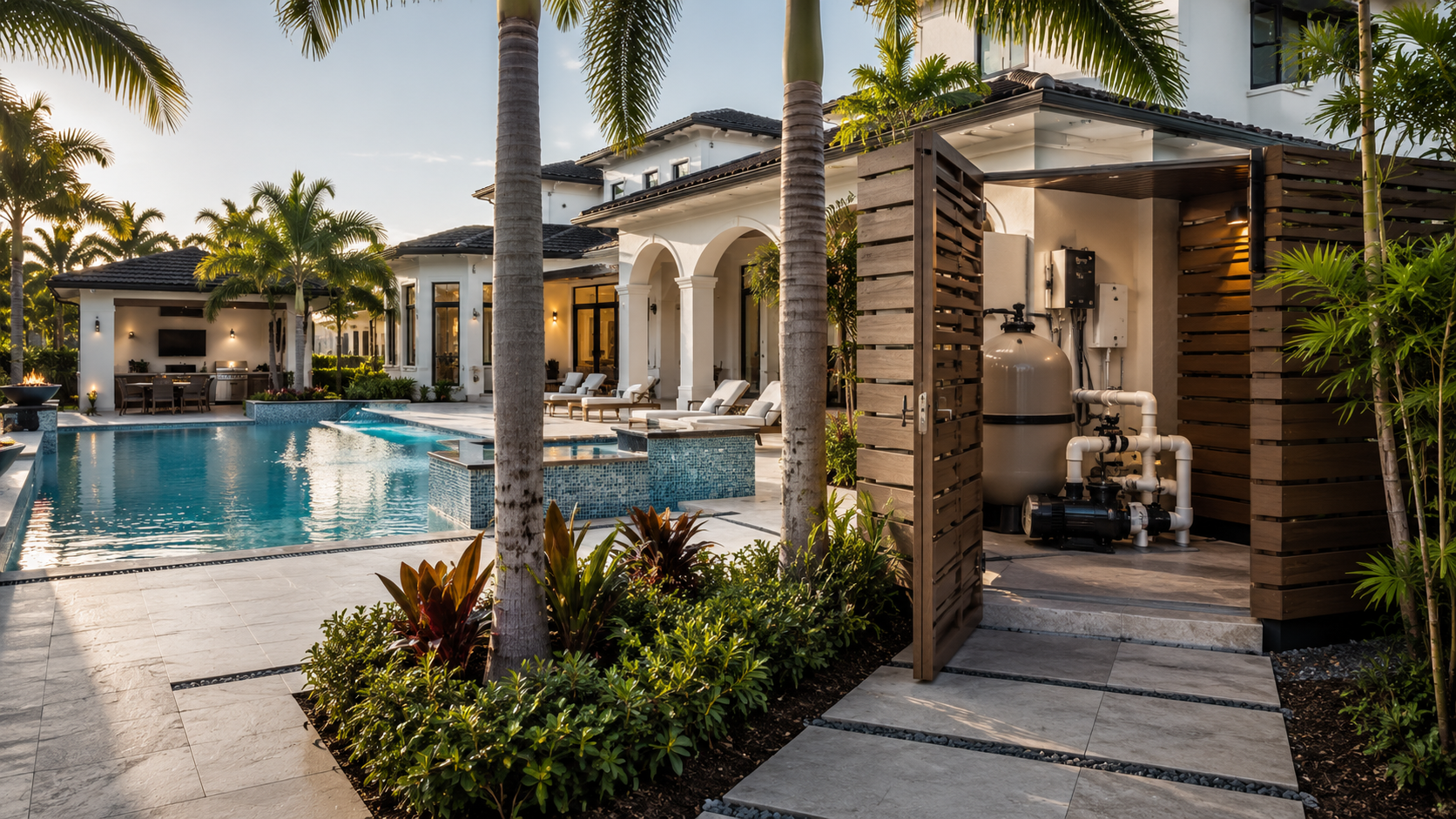
A backyard pool is only as beautiful as its weakest visual link, and for many homeowners, that weak link is the equipment pad. Pumps, filters, heaters, and automation systems are essential to a properly functioning pool, but they’re rarely designed to be looked at. Thoughtful pool equipment placement solves this problem, allowing homeowners to enjoy a polished, resort-style backyard while keeping every system easy to service. The key is planning early, understanding your options, and working with a design that balances aesthetics with practicality.
Why Pool Equipment Placement Matters More Than You Think
Too often, equipment placement is an afterthought. A contractor tucks the pad wherever there’s leftover space, and homeowners are left staring at a cluster of pipes, valves, and humming machinery every time they step onto the patio. Beyond the eyesore, poor placement can create real problems: noise carrying into outdoor living spaces, technicians struggling to reach shutoff valves, and heat exhaust from pumps venting directly into a seating area.
Getting pool equipment placement right from the start prevents these headaches. It also protects your investment. Pumps and filters that are difficult to access often get neglected, which shortens their lifespan and leads to costly repairs. When equipment is positioned thoughtfully, routine maintenance becomes simple, and the visual impact on your outdoor space is minimal.
Start With Function, Then Design Around It
Before choosing how to disguise your equipment, work with your builder to determine the ideal functional location. A few non-negotiables should guide this decision:
- Proximity to the pool. Shorter pipe runs mean better hydraulic efficiency and lower energy costs.
- Ventilation. Pumps and heaters generate heat and, in the case of gas heaters, combustion byproducts that need to vent safely.
- Noise control. Equipment should be positioned away from bedrooms, home offices, and outdoor dining areas whenever possible.
- Code compliance. Local regulations often dictate minimum clearances from property lines, structures, and combustible materials.
Once the functional footprint is set, the design conversation can begin. This is where a well-planned pool equipment enclosure becomes the centerpiece of the solution.
Pool Equipment Enclosures: Form Meets Function
A pool equipment enclosure is any structure built specifically to conceal pumps, filters, heaters, and automation panels while still allowing airflow and technician access. The best enclosures are custom-built to match the architectural style of the home, rather than treated as a generic utility box.
Popular enclosure approaches include:
Lattice or slatted wood screens: These allow for excellent airflow, which is critical for equipment that generates heat, while softening the visual impact with a natural material. Slatted screens can be stained or painted to match fencing or exterior trim.
Stucco or masonry walls: For homes with a more formal or Mediterranean aesthetic, a short stucco wall with a locking access gate can mirror the home’s exterior finish, making the enclosure feel like an intentional architectural feature rather than a hidden necessity.
Decorative metal screens: Powder-coated aluminum or steel panels with cutout patterns offer a modern look while maintaining ventilation. These are particularly popular in contemporary Florida pool designs.
Landscape screening: Dense plantings such as clusters of clumping bamboo, viburnum hedges, or podocarpus can soften or fully obscure equipment, though this option requires more long-term maintenance and careful spacing to preserve airflow.
Whichever style you choose, the enclosure should always include a removable panel or lockable gate sized generously enough for a technician to comfortably reach filters, pump baskets, and control panels.
Smart Pool Equipment Design Principles
Good pool equipment design goes beyond just building a box around the pad. It considers sightlines, sound, airflow, and future serviceability together as a single system.
A few principles that separate a well-executed equipment area from a poorly planned one:
- Orient the enclosure opening away from main sightlines. If the pad must sit near a patio, position the access side toward a side yard or utility path rather than facing the pool itself.
- Leave service clearance on all sides, not just the front. Technicians often need to access valves and unions from multiple angles.
- Elevate equipment on a pad to prevent flooding during heavy rain, which is especially important in Florida’s climate.
- Group equipment logically. Keep the pump, filter, heater, and automation panel close together to simplify wiring and plumbing runs, and to concentrate the “unattractive” footprint into one contained area rather than scattering components around the yard.
- Plan for future upgrades. Salt chlorine generators, automation systems, and variable-speed pumps are common upgrades; leave a little extra room in the enclosure design so you’re not tearing out walls later.
How to Hide Pool Equipment Without Blocking Access
Homeowners frequently ask how to hide pool equipment completely, and the honest answer is that “completely invisible” and “fully accessible” need to coexist by design, not by accident. A few practical strategies:
- Use hinged or removable panels instead of fixed walls, so a full section can swing open for major service work.
- Add gravel or paver flooring inside the enclosure to prevent mud and standing water around the equipment.
- Install a simple gate latch rather than a padlock for routine access, reserving locks for enclosures near public-facing areas.
- Route irrigation and lighting wiring around, not through, the equipment footprint to avoid future conflicts during repairs.
Skipping access planning to save space is one of the most common regrets homeowners have after their pool is complete. A slightly larger enclosure that allows comfortable technician access will always outperform a cramped one that looks fine on paper but is miserable to service.
Creating a Luxury Pool Equipment Area
For homeowners investing in a high-end backyard, the equipment pad doesn’t have to be purely utilitarian. A true luxury pool equipment area treats the enclosure as an extension of the home’s architecture. Think matching rooflines, coordinating stone veneer, integrated landscape lighting, and even a small covered structure that echoes a cabana or pool house design.
Some luxury builds incorporate the equipment enclosure into a broader structure, such as a pool house wall or an outdoor kitchen backdrop, so the utility area disappears into the design narrative of the space rather than standing apart from it. This approach works especially well on larger properties where the equipment pad can be positioned a bit farther from the main entertaining area.
Final Thoughts
Effective pool equipment placement is one of those details that homeowners rarely think about until construction is already underway, but it has an outsized impact on both the look and long-term function of a backyard pool. By planning the functional layout first, choosing an enclosure style that fits your home’s architecture, and never compromising on technician access, you can enjoy a beautiful, low-maintenance pool area without ever thinking twice about what’s happening behind the screen.
If you’re planning a new pool or renovating an existing one, talk to your builder early about equipment placement options. It’s a conversation that costs nothing upfront and pays off every time a technician visits or a guest steps onto your patio.
0 Comments