

I’ve watched a lot of homeowners make the same mistake. They get swept up in the glossy pictures, the grottos, the rock waterfalls, the freeform lagoons that snake around the yard, and then two summers later they’re exhausted. Their pool owns them.
That’s backwards.
If you’re spending real money on a backyard retreat in Florida, the whole point is to enjoy it. Not to spend every Sunday afternoon wrestling with a skimmer net. Not to keep a closet full of chlorine tablets. Not to call the pool guy for the third time this month because the water turned cloudy again.
The good news is that you don’t have to choose between luxury and low maintenance anymore. Modern design and technology have made that trade-off obsolete. But getting there requires making the right decisions before the first shovel hits the dirt.
Let me walk you through what actually works.
Keep the Shape Simple (Your Future Self Will Thank You)
This is the hardest sell I have with clients. Everyone wants the dramatic freeform pool with the tight curves and the hidden coves. It photographs beautifully. It looks like a resort.
It’s also a maintenance nightmare.
Here’s the thing about curves and tight corners, that’s where stuff collects. Leaves, dirt, pollen, sunscreen residue. It all settles into those little pockets where your cleaner can’t reach and your filter can’t pull from. Algae figures out those spots fast. Before you know it, you’re brushing the same corner every week and dumping in extra shock just to stay ahead of it.
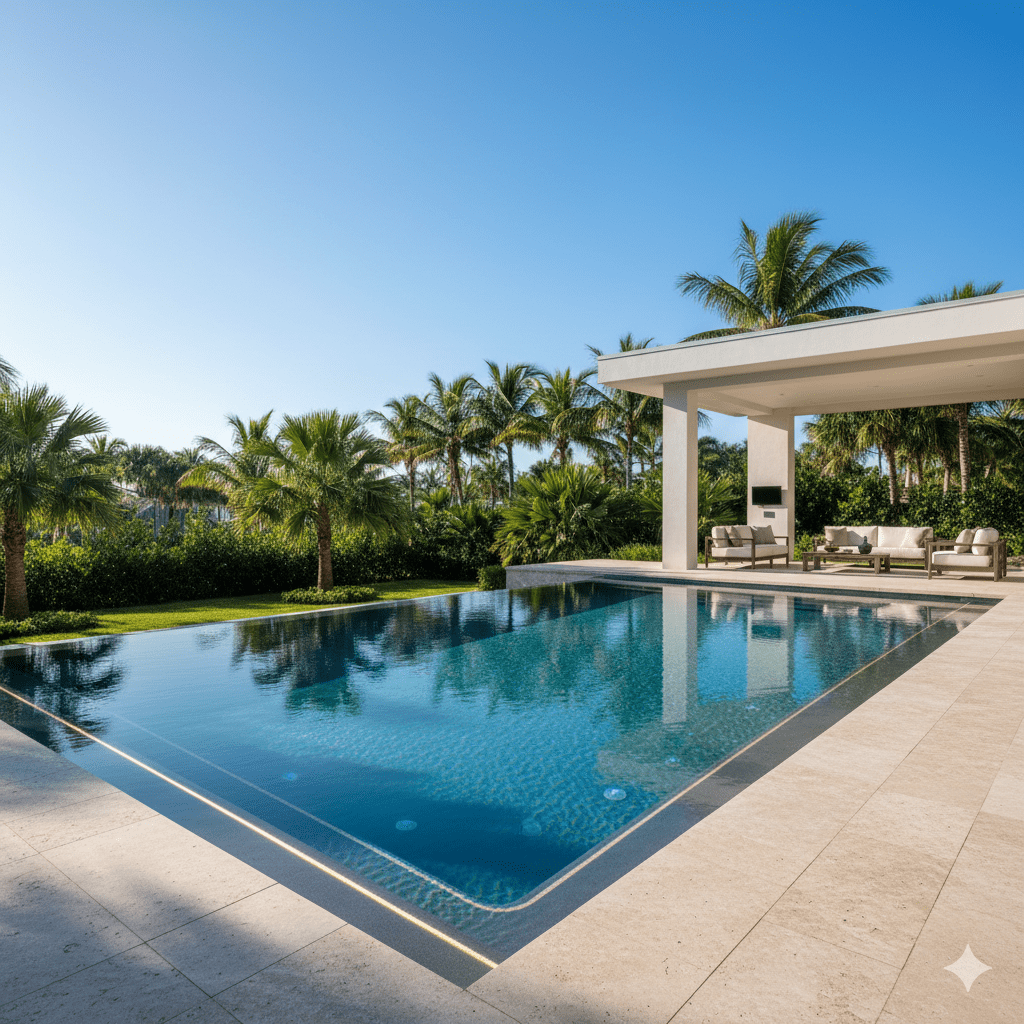
A clean rectangle or an L-shape doesn’t have those hiding spots. Water moves through it efficiently. Your cleaner covers every inch. Your chemicals distribute evenly. You use less of everything and spend less time on everything.
That’s not boring design. That’s smart design.
The other thing people forget is what’s growing around the pool. Florida landscaping is gorgeous, but a ficus hedge dropping leaves into your water every time the wind shifts is a full-time job. I steer clients toward low-shedding options, ornamental grasses, succulents, certain palms that don’t dump debris. It makes a bigger difference than you’d think.
And if you’re in a part of the state where screen enclosures make sense, get one. They keep the bugs out, cut the UV exposure, and stop a huge percentage of debris from ever reaching the water. Combined with a properly sloped deck and wide coping, you’ve just eliminated most of what would have ended up in your filter.
Let the Robots Handle It
I remember when “automatic pool cleaner” meant a creepy crawler that hooked up to your suction line and sort of wandered around. Those things were better than nothing, but not by much.
Today’s robotic cleaners are a different animal entirely. They’re independent units with their own motors and filters. They climb walls. They scrub the waterline. They run on a schedule you set from your phone. All you do is pull out the debris canister every couple of days and rinse it off. That’s a two-minute job.
But the real transformation is in the smart automation systems. You can control pump speed, lighting, heating, and chemical dosing from an app. You can check your water chemistry without walking outside. You can adjust the temperature before you get home from work.
The salt chlorine generator is the piece most Florida homeowners end up loving the most. Instead of buying, storing, and handling chlorine tablets, the system converts salt into chlorine on its own. Pair that with an automatic chemical monitor that reads your water throughout the day and injects exactly what it needs, and you’ve basically hired a full-time pool manager who never sleeps.
Is it a significant upfront investment? Yes. Is it worth it? Every single client who’s done it says the same thing, they’d never go back.
Pick Materials That Can Take the Punishment
Florida is not gentle on outdoor surfaces. The sun bleaches everything. The humidity breeds mildew. The rain comes sideways. And every few years, a hurricane reminds us who’s in charge.
You need materials that can handle all of it without looking tired after five years.
For the interior finish, skip standard white plaster. It’s cheap upfront, but it stains easily and starts showing its age around year seven. Pebble-aggregate and quartz plaster finishes cost more, but they resist staining, hold up to chemical erosion, and keep their color for 15 to 20 years. Do the math, it’s not even close.
For the deck, porcelain pavers are the clear winner. They don’t get slippery when wet. They don’t fade. They don’t absorb stains. You can spill sunscreen on them and hose it off. Travertine looks beautiful, but it’s porous, and once it soaks up pool chemicals and lotion, it’s never quite the same. Porcelain just wipes clean.
Glass mosaic tile along the waterline is another upgrade worth considering. It resists calcium buildup, and the color stays vibrant for decades. It’s the kind of detail that makes the whole pool look more expensive.
The Pump and Filter Setup That Pays for Itself
Florida requires variable-speed pumps on new pools now. Some people see that as government overreach. I see it as the best thing that ever happened to pool ownership.
These pumps run at lower speeds for longer stretches. They use up to 90% less electricity than the old single-speed models. And because they’re running longer, they’re actually filtering your water more thoroughly. Cleaner water means fewer chemicals. Fewer chemicals means less money and less hassle.
Pair the pump with an oversized filter. A bigger filter catches more before it needs cleaning. You’ll backwash less often. You’ll replace cartridges less often. Everything just lasts longer and works better.
The Maintenance Habits That Actually Move the Needle
Automation handles the day-to-day. But there are a few things you should still do yourself.
First, don’t pay for weekly service if you don’t need it. With a robotic cleaner and automatic chemical dosing, you can drop to a monthly professional visit. That visit is for a deep equipment inspection, a filter check, and a backup water test. You’re not paying someone to skim leaves you could have skimmed yourself. You’re paying for expertise.
Second, get a cover. A retractable automatic cover is the single best accessory for a Florida pool. It stops evaporation, which is a real problem when it’s 95 degrees and sunny, keeps debris out, and holds heat in during the cooler months. It cuts your chemical use and your heating bill at the same time. I’ve had clients tell me it paid for itself in two seasons.
Third, stay on top of phosphates. Florida’s groundwater and all the organic debris blowing around introduce phosphates into your pool. Phosphates are algae food. If you remove the food, you prevent the algae. Use a phosphate remover as part of your routine, and you’ll spend far less time fighting green water.
Fourth, keep a simple log of your water chemistry. Your automation system might track it for you. If not, jot down the readings once a week. Catching a small pH drift early is easy. Correcting a major imbalance after it’s been brewing for two weeks is not.
The Luxury Features That Don’t Create Work
Here’s the part people don’t expect, some of the most luxurious features are also the easiest to maintain.
Infinity edges? Zero extra maintenance. Built-in sun shelves? They’re shallow, they’re easy to clean, and they give you a spot to put potted aquatic plants without adding debris to the main pool. Underwater LED lighting? Uses a fraction of the energy of old bulbs and lasts for tens of thousands of hours. You’ll probably never replace one.
Deck jets and bubblers are also worth considering. They add movement and sound, and they run on simple plumbing that ties right into your automation system. The key is to avoid the complicated stuff, grottos, elaborate rock formations, multi-tiered waterfalls. They look incredible in a showroom. In your backyard, they become places for algae to hide and for you to spend your weekends scrubbing.
The Short Version
Designing a low-maintenance luxury pool in Florida comes down to a series of decisions. Keep the shape simple. Invest in automation. Choose materials that can survive our climate. Stick to a few smart habits. Skip the features that create work instead of eliminating it.
Do those things, and you end up with a pool that runs itself. You swim when you want. You relax when you want. You don’t spend your weekends maintaining a piece of equipment that was supposed to make your life better.
That’s the real luxury. Not the waterfall. Not the lighting. The fact that you can actually enjoy the thing without it becoming a second job.

0 Comments