

Nobody Wants a Cage Anymore. They Want This.
I’ve watched backyard pools in this part of Florida for a long time, and I’ll say the unpopular thing: the screen enclosure used to be the ugliest thing on a nice property. White aluminum, flat roof, bolted to the patio like an apology. Functional. Necessary. And completely at odds with the house it was attached to.
That era is over. What’s replaced it is genuinely one of the more interesting shifts in how people build here, and most folks don’t even notice it happening.
Blame the bugs, thank the designers
Start with why the cage exists at all. Our climate is not gentle. The mosquitoes alone would keep you inside from May to October. Add no-see-ums near the canals, lovebugs twice a year, palm fronds in the water after every blow, and an open pool becomes a second job. Screening it in was never a luxury. It was survival.
So for years, that’s all anyone asked of the cage, keep the bugs out, keep the leaves out, done. The design question never came up.
It comes up now.
The view stopped being negotiable
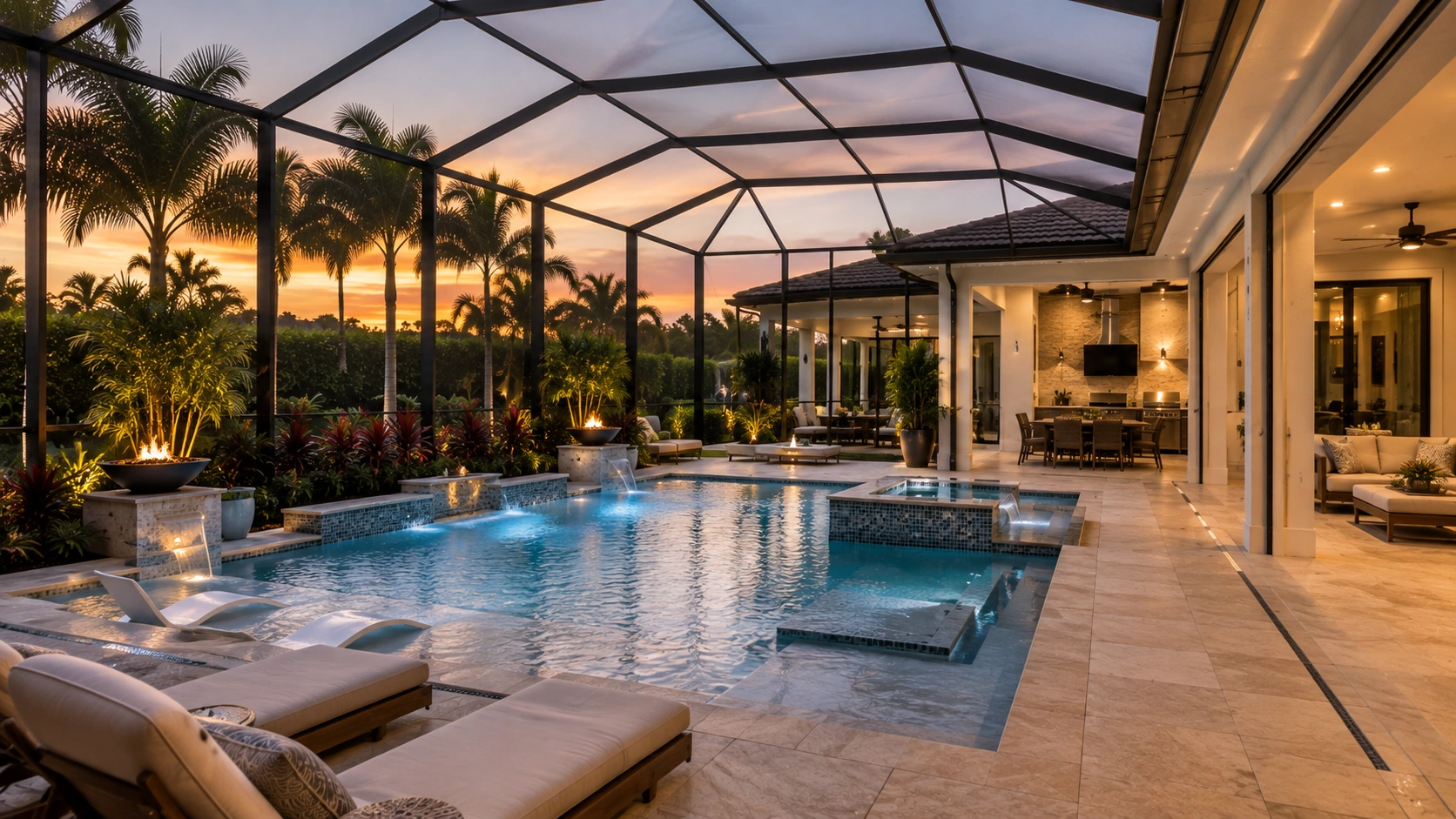
The first thing that changed was the screening itself. Picture-frame and panoramic mesh pull the visible structure back until you’re barely aware of it. On the water, or looking out over a preserve, that’s not a small detail. You paid for that view. Blocking it with chunky beams and a low flat roof defeats the whole point of living here.
Then the rooflines loosened up. Higher pitches. Shapes that pick up the house instead of ignoring it. A Mediterranean place gets a different treatment than a modern build, and both get something better than the same dome every neighbor has. The framing colors followed, bronze and black mostly, finishes that sit well against stone decking and dark-bottom pools rather than the old bright white that made everything look like a commercial building.
And lighting went inside the structure. No more string of fixtures around the lanai. The cage itself glows.
The part that actually matters
All of that is nice. Here’s what really changed: people started designing the enclosure at the same time as the house, not after.
That sounds boring. It isn’t. When the cage is in the plan from the beginning, the ceilings can match between inside and out. The sliding doors pocket into a wall that was built for them. The footprint gets sized for a real kitchen and real furniture instead of whatever fits. The whole back of the house starts working as one space.
I’ve walked into lanais where you genuinely can’t tell where the house stops. That’s the goal. Not a structure out back. Another room.
What “luxury” is actually buying
When a project gets called a luxury screened pool, it usually means the pool, cage, deck, and landscaping were designed together as one thing. The enclosure is load-bearing for the design, not decoration.
You’ll see super-screen mesh for clarity, cages tall enough to clear mature palms, motorized shades, frames built around infinity edges and sun shelves and spas. None of that works with an off-the-shelf cage. Those features need a frame designed for them from the start.
Now the unglamorous part. Our wind codes are among the strictest anywhere. Every enclosure has to be engineered for real wind loads, full stop. The more open and dramatic the design, the more engineering it takes. Good local builders know this without being told. They can give you the airy look and still sleep at night in August.
Two honest warnings
First: this costs real money and takes real time. A custom enclosure is a design project, not a purchase. If someone quotes you a flat price off a catalog, you’re getting the old white box with a new coat of paint.
Second: a bad builder can ruin a good design. Ask what they’ve built that looks like what you want. Look at it in person. The engineering is invisible when it’s done right and very visible when it isn’t.
If you’re putting in a pool, or you’ve got a cage from twenty years ago that’s done its time, it’s worth sitting down with someone who knows both the design side and the code side. The gap between an afterthought and a designed enclosure is not subtle. You feel it the second you walk outside.
So what’s your backyard doing right now?

0 Comments