

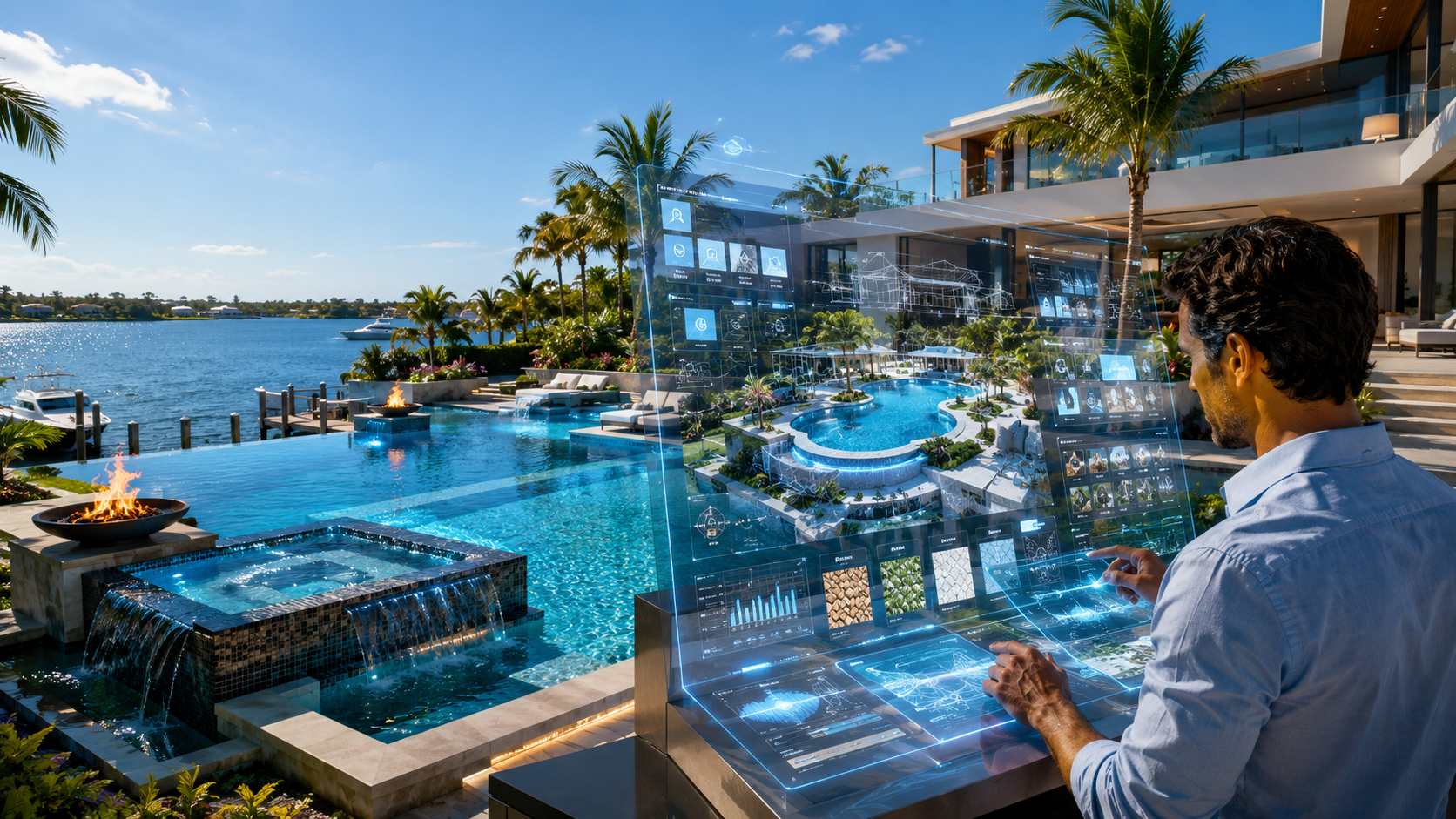
How AI Is Transforming Luxury Pool Design and Backyard Planning in Florida
Florida has always been a state built around water. From Miami’s waterfront estates to the golf-course communities of Naples and Sarasota, the backyard pool isn’t a luxury add-on here; it’s a way of life. But the way homeowners and builders are getting from concept to finished pool has changed dramatically in the last few years. AI pool design is now reshaping how Florida homeowners plan, visualize, and build their dream backyards, replacing guesswork and lengthy revision cycles with fast, data-driven precision.
Why Florida Is Ground Zero for This Shift
Florida’s pool market is enormous and highly competitive. With over a million residential pools statewide and thousands more added every year, builders are under pressure to deliver faster proposals, more accurate quotes, and designs that actually reflect what a client wants the first time. Add in Florida-specific realities, hurricane codes, flood zones, HOA restrictions, and intense sun exposure, and it’s easy to see why AI-powered tools have found such fertile ground here. Traditional design methods, which relied on hand sketches, static 2D renderings, and multiple in-person consultations, simply couldn’t keep pace with demand.
This is where AI pool planning platforms have stepped in, giving contractors and homeowners a shared visual language before a single shovel hits the ground.
From Sketch to Simulation: What’s Actually Changed
A decade ago, planning a backyard pool meant flipping through a catalog of shapes, choosing a finish, and hoping the final result matched what was in your head. Today, smart pool design software can take a photo of an existing backyard, map its dimensions, and generate a realistic 3D model within minutes. Homeowners can rotate the view, change the water color, swap tile patterns, or add a spa, sun shelf, or fire feature, all before committing to a contract.
Some of the most useful advances include:
- Automated site analysis. AI tools can now assess drainage patterns, sun exposure throughout the day, and existing landscaping to recommend optimal pool placement.
- Instant material and cost estimation. Machine learning models trained on thousands of past projects can predict material needs and rough budgets almost immediately, cutting down the back-and-forth of manual quoting.
- Code and setback compliance checks. Since Florida counties vary widely in permitting requirements, some platforms cross-reference local codes automatically, flagging potential issues with setbacks or easements before a design is finalized.
- Climate-aware planning. AI systems can factor in Florida’s heat, humidity, and storm patterns to suggest shading structures, energy-efficient pumps, and hurricane-resistant equipment enclosures.
Custom Pool Visualization: Seeing Before Building
Perhaps the most immediately compelling benefit for homeowners is custom pool visualization. Rather than trying to picture an infinity edge or a raised spa from a flat drawing, clients can now walk through photorealistic renderings, and in some cases, immersive 3D or augmented reality views of their exact backyard with the proposed pool in place.
This matters enormously in Florida, where outdoor living spaces often function as an extension of the home itself. Homeowners want to know how a sunset will hit the water at 6 p.m. in July, whether a cabana will block a sightline from the kitchen, or how a paver pattern will look against St. Augustine grass. AI-driven visualization tools answer these questions in real time, letting clients try dozens of design iterations without waiting weeks for a revised rendering. The result is fewer costly change orders mid-construction and a much higher rate of first-time design approval.
Luxury Backyard Design Goes Beyond the Pool
Modern luxury backyard design in Florida rarely stops at the water’s edge. Outdoor kitchens, pergolas, fire pits, putting greens, and pool houses are now standard requests in high-end projects, and AI tools are increasingly capable of designing these elements as a cohesive whole rather than as separate add-ons.
AI-assisted planning platforms can generate full backyard master plans that account for traffic flow, shade coverage, privacy sightlines, and even how outdoor lighting will look after dark. For designers, this means less time spent manually drafting iterations and more time refining the details that make a space feel bespoke, a hand-selected stone edge, a custom mosaic at the pool’s deep end, or a water feature tuned to a specific ambient sound level.
Some firms are pairing this with generative design, where an AI system proposes multiple layout options based on a client’s stated preferences (family-friendly, entertaining-focused, spa-like retreat) and lets the homeowner select a starting point rather than beginning from a blank page.
What This Means for Florida Homeowners
For homeowners, the practical benefits are significant:
- Faster timelines. Design approval that once took weeks can now happen in days, since revisions are visual and immediate rather than requiring new hand-drawn plans.
- Fewer surprises. Seeing a near-final render before construction begins reduces the gap between expectation and reality.
- Better budget control. Early AI-generated cost estimates help homeowners make informed choices about finishes and features before they’re locked into a contract.
- More personalization. Because iteration is cheap and fast, clients can explore more creative options, vanishing edges, natural lagoon-style pools, or resort-style grottos, without ballooning design fees.
Where This Is Headed
As adoption grows, expect AI pool design tools to become even more predictive, suggesting energy-efficient equipment based on a home’s actual usage patterns, recommending native landscaping that thrives in Florida’s climate with minimal water use, and integrating directly with smart home systems so pool heating, lighting, and water features can be managed from a single app.
For a state where the backyard pool is central to daily life, this shift isn’t just a matter of convenience. It’s changing the relationship between homeowner and designer, turning what used to be a leap of faith into a collaborative, visual, and far more precise process. Florida’s luxury pool market was already competitive; now it’s becoming smarter, faster, and more tailored to the way people actually want to live outdoors.

0 Comments