

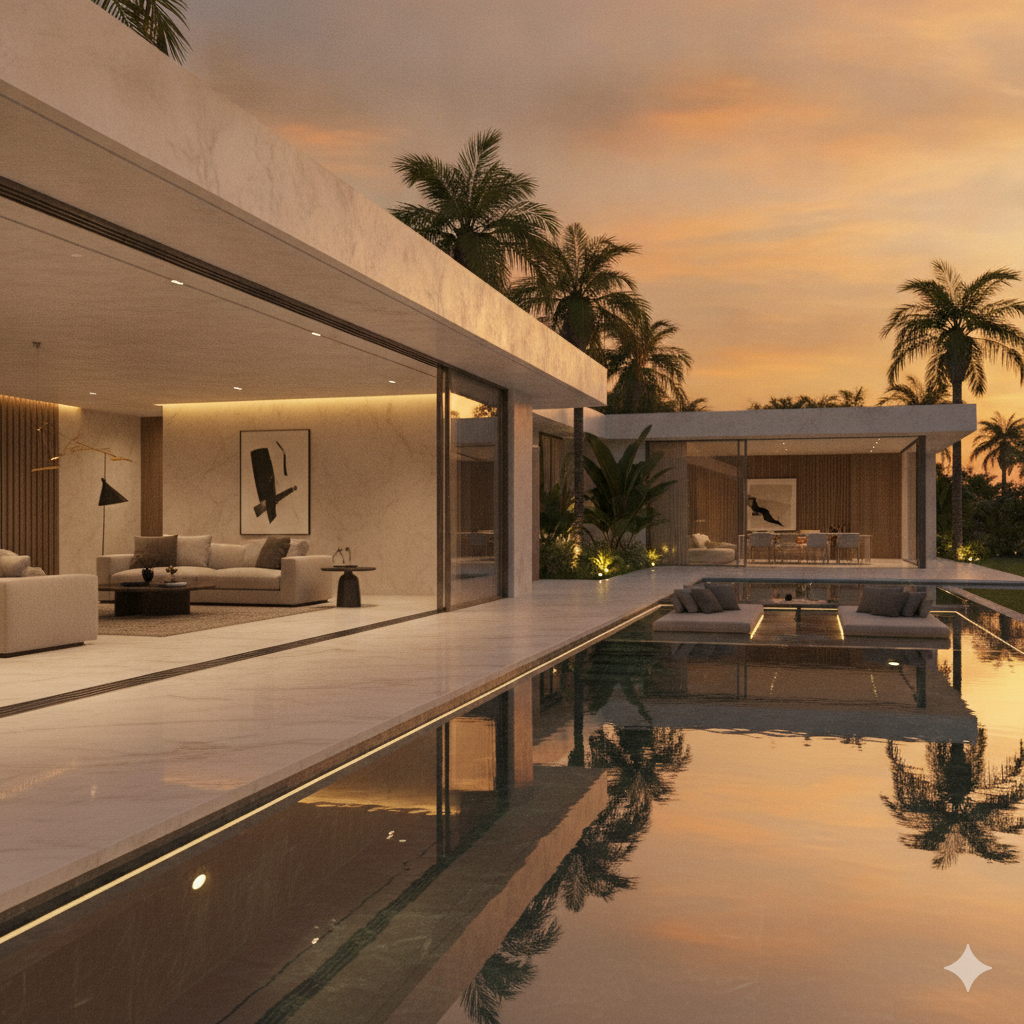
Creating Seamless Indoor-Outdoor Living with Custom Pool Design
There’s a moment, standing barefoot on warm travertine, the scent of jasmine drifting through an open glass wall, the shimmer of pool water casting rippled light across your ceiling, when the line between inside and outside simply disappears. That moment is the promise of indoor outdoor living, and for homeowners across the Sunshine State, a custom pool is the design element that makes it possible.
Florida’s climate practically begs for this lifestyle. With more than 230 sunny days a year, the boundary between your home and your backyard shouldn’t feel like a wall. It should feel like a threshold, one you cross without thinking.
Why Indoor-Outdoor Living Starts at the Pool
Most homeowners think of a pool as an amenity. The best designers think of it as architecture.
When a pool is designed in isolation, dropped into a yard as an afterthought, it competes with the home rather than completing it. But when pool integration is considered from the earliest stages of design, something transformative happens. The pool becomes the visual anchor of your entire property. Every sightline, every doorway, every lounge chair gets oriented around it.
This is how great homes are designed in places like Naples, Sarasota, and Palm Beach: the pool isn’t added to the house; the house is built around the pool. Living rooms open directly onto pool decks through 10-foot pocket doors. Master bedrooms feature floor-to-ceiling glass that frames the water like a painting. Kitchen islands align with outdoor bars so conversation never has to pause when someone steps outside.
True indoor-outdoor living isn’t about having a pool and a nice patio. It’s about dissolving the distinction between the two.
Designing Outdoor Entertainment Areas That Flow Naturally
One of the biggest mistakes homeowners make is treating their outdoor entertainment areas as a separate “zone” from the rest of the home. In reality, the most successful designs create a continuous social ecosystem, a fluid path from kitchen to covered lanai to pool deck to open lawn.
Think about how a dinner party actually moves. Guests start inside, drift toward the kitchen, spill onto the covered patio, congregate near the outdoor kitchen, and eventually find themselves at the edge of the pool with a drink in hand. A great outdoor entertainment design doesn’t fight this movement, it choreographs it.
Practical elements that enable this flow include:
- Zero-threshold transitions between interior floors and exterior decks, so there’s no step, no stumble, no subconscious signal that you’ve left the party
- Consistent materials that carry from inside to outside, a large-format porcelain tile that works both indoors and on the pool deck creates visual continuity
- Covered transition zones like deep lanais or pergolas that feel neither fully inside nor fully outside, easing the psychological shift
- Outdoor kitchens positioned parallel to indoor kitchens, often separated only by a pass-through window or retractable glass wall
Lighting deserves special attention here. The best outdoor entertainment spaces use layered lighting, ambient, task, and accent, just like interior rooms. Pool lighting, path lighting, and architectural uplighting work together after sunset to make the outdoor space feel as warm and intentional as anything inside.
The Elements of Luxury Backyards in the Florida Context
Luxury backyards in Florida aren’t defined by size. Some of the most breathtaking private retreats are found on modest lots in older neighborhoods, where a skilled designer has transformed a small footprint into a dense, layered experience. What separates a luxury backyard from an ordinary one is density of intention: every square foot has been considered.
For Florida living specifically, several design elements consistently elevate a pool and backyard from beautiful to extraordinary:
Infinity or perimeter-overflow edges create the illusion of water extending to the horizon, particularly stunning on waterfront lots, but equally dramatic on an elevated yard with a view of a golf course or preserve.
Sun shelves and tanning ledges, shallow, submerged platforms with six to ten inches of water, allow homeowners to lounge in the water without swimming. Add a bubbler or two, a couple of chaise lounges, and an umbrella sleeve, and you have an in-pool relaxation zone that rivals any resort.
Spa integration is another hallmark of high-end pool design. A spa that spills into the main pool via a raised spillway adds visual drama and creates a natural gathering spot. When positioned near the covered lanai, a spa becomes a social anchor, the place guests gravitate toward on cooler evenings.
Natural materials and tropical plantings tie the design to its environment. In Florida, this might mean lush landscaping with bird of paradise, traveler’s palms, and ornamental grasses that create a layered green backdrop for the pool. Combine this with natural stone coping, carved coral feature walls, or a grotto element, and the space begins to feel less like a backyard and more like a private sanctuary.
Bringing It All Together: The Design Process
Creating a truly seamless indoor-outdoor living experience requires collaboration between the homeowner, the pool designer, the landscape architect, and ideally the home’s architect or interior designer. These disciplines have to speak to each other.
That starts with a conversation about how you actually live. Do you host large gatherings, or do you prefer intimate evenings? Do your children swim competitively, or is the pool primarily for relaxing? Do you cook outside regularly, or is outdoor dining more occasional? The answers to these questions shape everything, from pool shape and size to the placement of shade structures to the lighting palette.
The best custom pool designers don’t just build pools. They build environments. They think about acoustics (the sound of water from a spillway can mask traffic noise and create a sense of seclusion). They think about thermal comfort (the orientation of a shade structure matters by the hour). They think about privacy (strategic planting or architectural screens can transform an exposed suburban yard into an intimate retreat).
The Investment in How You Live
A custom pool designed for genuine indoor-outdoor living is an investment, not just in your property’s value, but in the quality of your daily life. When your home is designed so that inside and outside breathe together, something shifts. Morning coffee becomes a ritual beside still water. Summer evenings stretch out languidly between the kitchen and the pool. Weekends feel like vacations.
In Florida, where the climate invites this life almost year-round, the question isn’t whether you can afford to design for indoor-outdoor living. It’s whether you can afford not to.

0 Comments