

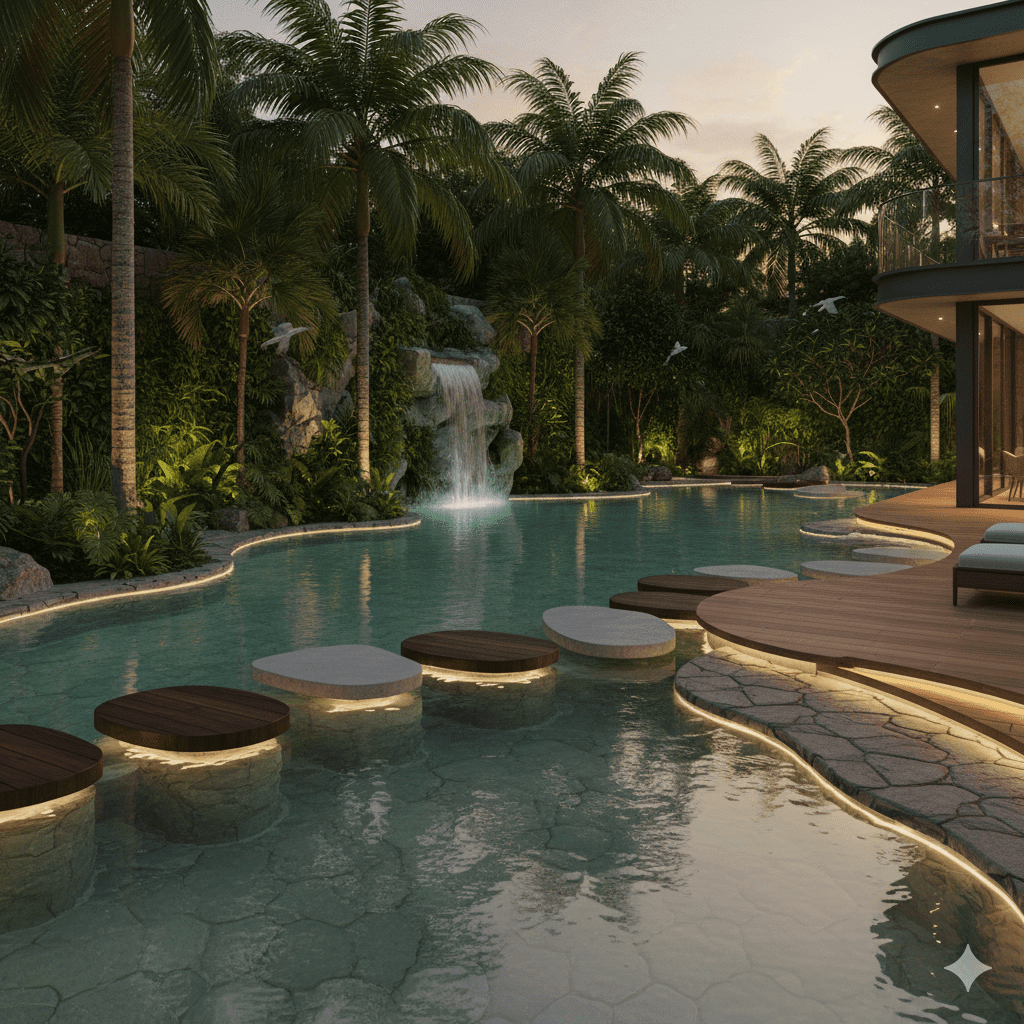
Biophilic Pool Design: Bringing Nature Into Luxury Backyards
There is a particular stillness that settles over a backyard when a swimming pool stops looking like a pool. When the edge softens into stone, when the water mirrors the canopy overhead, when dragonflies mistake it for a lake, that is the quiet promise of biophilic pool design. It is not a trend. It is a philosophy: the deliberate act of restoring the connection between human habitation and the living world, one luxury backyard at a time.
What Is Biophilic Pool Design?
Biophilia, literally, love of living systems, is the innate human tendency to seek connection with nature. Research consistently shows that proximity to natural environments reduces cortisol, lowers blood pressure, and improves cognitive function. When this principle is applied to pool architecture and outdoor living spaces, something remarkable happens: the backyard swimming pool transforms from a geometric amenity into an immersive, sensory environment that evokes the feeling of a mountain spring, a jungle clearing, or a coastal tidal pool.
Biophilic pool design is defined not just by aesthetics but by intention. Every material choice, every planting decision, and every structural contour is made in service of one idea: that being in this space should feel ancient, wild, and deeply restorative. For luxury homeowners increasingly drawn to wellness-centred living, no design movement speaks more directly to that desire.
The Pull of Nature-Inspired Pools
The most compelling nature-inspired pools share a quality that is difficult to articulate but immediately felt: they seem to belong exactly where they are. They do not arrive in a backyard; they appear to have always been there, slowly revealed by the removal of everything that was not essential.
This sense of inevitability is achieved through a combination of careful siting, material authenticity, and ecological sensitivity. A nature-inspired pool reads the existing landscape, its slope, its light, and its established vegetation and responds to those conditions rather than overriding them. Boulders are placed where geology would place them. Water spills at the lowest point, as it always would. The result is a space that triggers the same deep recognition we feel standing at the edge of a natural body of water: a sensation that something here is exactly right.
The Architecture of Organic Pool Shapes
The first and most visible departure from conventional pool design is the rejection of the rectangle. Traditional pools are defined by right angles, efficient, symmetrical, and unmistakably man-made. Organic pool shapes, by contrast, draw their geometry from riverbeds, tidal pools, and glacial lakes. Edges undulate. Depths vary unexpectedly. No two points of the perimeter are equidistant from the centre.
These irregular forms achieve something psychologically powerful: they prevent the eye from fully mapping the space in a single glance. A pool with a curved, boulder-flanked edge creates a sense of depth and mystery that a standard lap pool never could. This cognitive uncertainty, this sense that there is more to explore, is precisely what makes a natural body of water so captivating. The finest biophilic pool designers encode that quality into concrete, stone, and water.
Practically, organic pool shapes open up a far richer vocabulary of features. Ledges that descend gradually like a river’s shallows. Beach entries that slope gently into the water, eliminating the hard line of a step or ladder. Coves that tuck under overhanging rock formations and invite moments of quiet shelter. Peninsulas of planting that reach into the water and blur the boundary between pool and garden. Each of these elements deepens the experience and extends the visual narrative of the space.
Eco Luxury Pool Design: Beauty With a Conscience
Luxury and environmental responsibility were once assumed to be in tension. Eco luxury pool design rejects that assumption entirely. Today’s most sophisticated outdoor pools operate with remarkably reduced ecological footprints, using systems that are as intelligent as they are beautiful.
Natural swimming pools, sometimes called bio-pools, replace chemical filtration with planted regeneration zones, where aquatic plants and beneficial microorganisms perform the work of purification. The result is water that is genuinely alive: soft on the skin, free of chlorine, and rich with the beneficial biology that makes natural water feel restorative rather than sterile. These systems require more upfront design expertise but reward owners with a maintenance profile that is, over time, both simpler and cheaper than conventional alternatives.
For clients who prefer the clarity and control of conventional filtration, eco-conscious alternatives abound. Saltwater chlorination systems are gentler on swimmers and the surrounding landscape. UV and ozone purification dramatically reduce chemical dependency. Solar thermal panels eliminate the carbon cost of heating. Rainwater harvesting systems capture and store rainfall for pool top-up, reducing mains water consumption significantly.
Natural Landscaping Pools: Where Water Meets Wilderness
A biophilic pool does not end at the waterline. The surrounding landscape is as important as the pool itself, and in the most compelling installations, it is nearly impossible to say where one ends and the other begins. Natural landscaping pools are embedded within their environment rather than placed upon it.
Native planting is the foundation of this approach. Species chosen for their regional authenticity thrive with minimal intervention and provide habitat for the insects, birds, and amphibians that complete a living ecosystem. Ornamental grasses that catch the wind create movement and sound at the pool’s periphery. Flowering aquatic marginals lean over the water’s edge, softening the transition between pool and garden. Ancient ferns colonise the spaces between boulders. Strategically placed specimen trees provide dappled shade, reduce evaporation, and create the sensation of swimming within a forest clearing.
Hardscaping follows the same logic of naturalness. Irregular sandstone, weathered granite, and moss-softened limestone replace poured concrete and ceramic tile. Gravel paths meander rather than march. Fire features are built from stacked natural stone. Every surface is chosen because it would not look out of place in the landscape it evokes.
Designing Your Own Biophilic Sanctuary
The first step toward a biophilic pool is a shift in perspective. Rather than designing a pool and then deciding what to plant around it, the most successful projects begin with the landscape, its topography, its existing vegetation, and its orientation to light, and allow the pool to emerge from those conditions.
Engage designers who understand both water engineering and ecological planting. Commission a site survey that identifies the existing biodiversity of your property. Choose materials sourced within a reasonable distance. And allow the design process to take its time: the finest biophilic pools are grown as much as they are built.
In the end, biophilic pool design offers something that no conventional amenity can: a private wilderness. A place where luxury is measured not in square footage or horsepower, but in the quality of silence, the temperature of the light, and the feeling, rare and deeply human, of belonging to something larger than yourself.

0 Comments